

Weatherproof Starlink Gen2 Extension Cable: Temperature, UV, and Installation Guide
Deploying high-speed satellite internet across rural properties, commercial facilities, and outdoor sites can present several environmental challenges. Installers and B2B buyers often ask: What does an operating temperature range of -20°F to 167°F (-29°C to 75°C) mean in real-world outdoor installations? Can freezing temperatures make the cable jacket stiff or cause it to crack?
Fortunately, 45P PVC jacketing provides strong protection against UV exposure, rain, moisture, and mechanical abrasion. However, extreme temperatures still require proper handling and installation procedures. Therefore, understanding the thermal limits of a weatherproof Starlink Gen2 extension cable is essential for maintaining long-term signal reliability and preventing cable sheath damage during tight routing.
This guide explains the thermal behavior of 45P PVC, its UV and moisture resistance, and the recommended installation practices for long-distance Starlink cable extensions.
1. Understanding the -20°F to 167°F Operating Temperature Range
Outdoor satellite cables must maintain their structural integrity across changing weather conditions. In particular, the cable jacket needs to resist cracking in freezing conditions while remaining stable under high temperatures and direct sunlight.
The following table summarizes the expected cable behavior at different temperatures:
| Temperature Range | Expected Cable Condition | Recommended Installation Practice |
|---|---|---|
| 100°F to 167°F (38°C to 75°C) | Flexible with a softer surface feel | Avoid sharp pulling over rough metal edges |
| 32°F to 99°F (0°C to 37°C) | Optimal flexibility and stiffness | Suitable for standard wall, roof, and conduit routing |
| -4°F to 31°F (-20°C to -1°C) | Increased stiffness while retaining elasticity | Pre-warm the cable before making tight bends |
| Below -22°F (Below -30°C) | High rigidity and increased brittleness risk | Avoid sharp bending until the cable has warmed |
Cold-Weather Installation and Cable Flexibility
At temperatures down to approximately -4°F (-20°C), 45P PVC can retain sufficient flexibility for common surface and aerial installations.
However, as temperatures fall below -22°F (-30°C), the PVC polymer structure becomes significantly stiffer. Therefore, installers working in freezing conditions should uncoil and pre-warm the cable indoors before routing it through tight conduit elbows or narrow wall penetrations.
This simple step can reduce excessive mechanical stress and help prevent jacket damage during installation.
2. UV Resistance, Moisture Protection, and Underground Installation
Outdoor satellite cables are exposed to continuous sunlight, rain, humidity, and temperature fluctuations. As a result, long-term cable performance depends not only on the conductor but also on the quality of the outer jacket.
UV-Stabilized 45P PVC Outer Jacket
Without suitable UV protection, standard PVC cable jackets can gradually degrade under prolonged sunlight. Surface cracking, fading, and embrittlement may eventually reduce mechanical protection.
By contrast, the 45P PVC formulation used for the extension cable incorporates UV-stabilizing and moisture-resistant properties. Therefore, it is suitable for applications such as:
- Rooftop Starlink installations
- Exterior wall mounting
- Outdoor cable routing
- Rural property installations
- Commercial facilities
- Remote outdoor sites
Proper routing remains important even when the cable uses a weather-resistant outer jacket.
Waterproof Protection vs. Direct Burial
The cable jacket and molded connector boots help protect the connection against rain, humidity, and surface water. In addition, properly fitted connectors and dust caps can further reduce exposure to moisture and contaminants.
However, weatherproof does not necessarily mean suitable for direct burial.
For underground installations, soil moisture, ground pressure, abrasion, and insects can gradually damage an exposed cable. Therefore, installers should route the cable through rigid PVC conduit or suitable flexible protective conduit when running it underground.
3. Nxcsxvs Starlink Gen2 150FT Extension Cable Architecture
Nxcsxvs develops long-distance weatherproof Starlink Gen2 extension cables for residential, commercial, and professional network installations. The cable combines plug-and-play compatibility, solid copper conductors, weather-resistant jacketing, and extended installation reach.
Direct Plug-and-Play Starlink Gen2 Compatibility
The cable is designed specifically for the rectangular Starlink Gen2 dish and router. Its molded connectors are designed to fit the corresponding native ports directly.
As a result, installers do not need additional adapters, modified connectors, or manual wire splicing for standard installations.
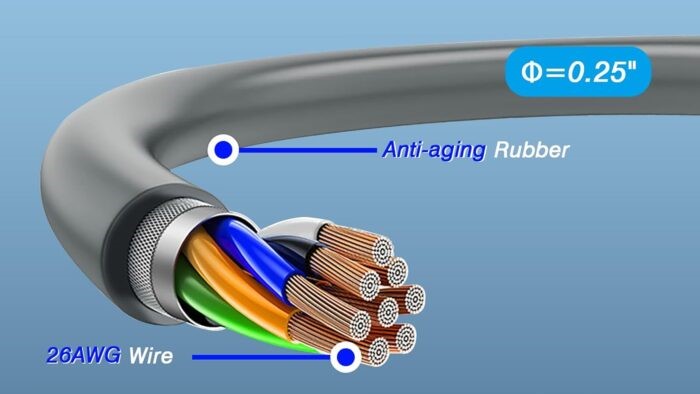
24AWG Solid Copper Conductors
The extension cable uses 24AWG solid single-core copper conductors to reduce electrical resistance across the extended cable length.
This construction supports stable data transmission and power delivery for long-distance installations.
Key performance benefits include:
- Data transmission: Supports speeds up to 1200Mbps
- Power delivery: Solid copper conductors help maintain stable power transmission
- Long-distance connectivity: Suitable for extended routing between the Starlink dish and router
- Reduced resistance: Helps minimize voltage loss across longer cable runs
These characteristics make the cable suitable for applications requiring both reliable connectivity and flexible installation distances.
4. 150FT Extension Length for Large Properties
The 150FT (45-meter) cable length provides additional flexibility when the Starlink dish cannot be installed close to the router.
For example, trees, multi-story buildings, roof structures, and distant mounting poles can create significant installation challenges. A longer extension cable allows installers to position the dish in a more suitable location while maintaining the required connection to the network equipment.
Therefore, the 150FT extension is suitable for:
- Rural homes and large properties
- Commercial buildings
- RV parks and outdoor facilities
- Remote industrial sites
- Farms and agricultural properties
- Temporary outdoor installations
This extended reach can simplify installation planning while providing greater flexibility for satellite dish positioning.
5. Standard Ethernet Cable vs. Weatherproof Starlink Gen2 Extension Cable
Choosing the right cable requires more than comparing cable length. Compatibility, conductor construction, weather resistance, operating temperature, and installation requirements should also be considered.
| Parameter | Standard Utility Ethernet Cable | Nxcsxvs Weatherproof Starlink Gen2 Extension Cable |
|---|---|---|
| Compatible Hardware | Generic RJ45 network devices | Starlink Gen2 rectangular dish and router |
| Conductor Type | 26AWG/28AWG stranded CCA | 24AWG solid single-core pure copper |
| Data Rate | 100Mbps–1000Mbps | Up to 1200Mbps |
| Outer Jacket | Standard 30P or low-grade PVC | Heavy-duty 45P weatherproof PVC |
| Operating Temperature | 32°F to 122°F (0°C to 50°C) | -20°F to 167°F (-29°C to 75°C) |
| Cable Length | 30FT–75FT typical short runs | 150FT / 45m |
| Outdoor Application | Limited depending on cable type | Designed for outdoor Starlink installations |
6. Best Practices for Installing a Weatherproof Starlink Gen2 Extension Cable
To maximize cable service life, installers should consider both environmental conditions and mechanical routing.
Avoid Sharp Bends
When temperatures are low, the PVC jacket becomes stiffer. Therefore, avoid forcing the cable into sharp bends during winter installation.
Pre-Warm the Cable in Extreme Cold
If the ambient temperature is below approximately -22°F (-30°C), allow the cable to warm before making tight bends or pulling it through narrow conduit sections.
Protect Underground Cable Runs
Although the cable is designed for outdoor exposure, direct burial can expose it to unnecessary mechanical and environmental stress. Use protective conduit for underground routing.
Avoid Abrasive Contact
During rooftop or exterior installation, avoid pulling the cable directly across sharp metal edges. Use cable clips, protective sleeves, or suitable routing channels where necessary.
Protect Connectors From Moisture
Ensure connectors are fully seated and use appropriate dust caps or sealing accessories where applicable. Proper connection management helps reduce moisture-related installation problems.
Technical Summary
Understanding the -20°F to 167°F (-29°C to 75°C) operating range of a 45P PVC jacket helps installers plan reliable Starlink deployments across different climates.
However, temperature resistance alone does not guarantee long-term cable performance. Proper routing, controlled bending, UV exposure management, connector protection, and underground conduit installation are equally important.
The weatherproof Starlink Gen2 extension cable from Nxcsxvs combines 45P PVC weather protection, 24AWG solid copper conductors, up to 1200Mbps data support, and a 150FT extended length.
As a result, it provides a practical connectivity solution for residential users, commercial operators, B2B distributors, OEM customers, and network integrators requiring longer Starlink Gen2 installation distances.
Nxcsxvs supplies Starlink extension cables, mounting accessories, and network connectivity products for distributors, OEM projects, and professional installation applications worldwide.